
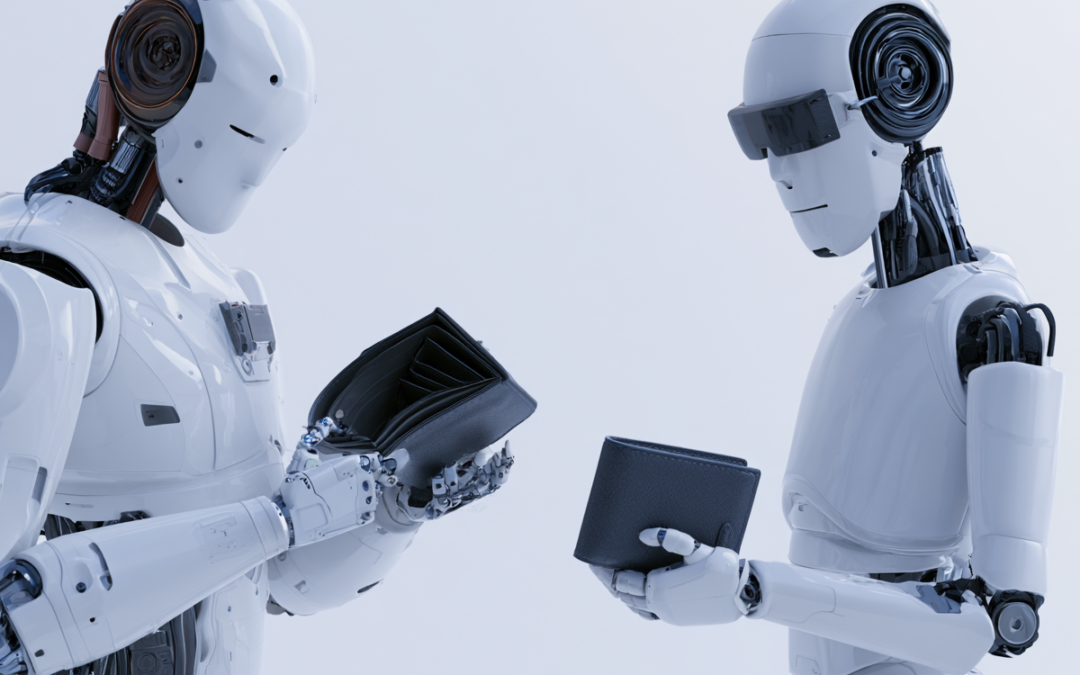
AI Agents Need Wallets: Why the Next Great Crypto Boom May Be Machine-to-Machine Finance
For most people, the idea of a crypto wallet still feels strange.
It sounds like something for traders, Bitcoin holders, NFT collectors, DeFi users, or people who spend too much time on crypto Twitter.
But the next generation of wallets may not be designed only for humans.
They may be designed for machines.
That sounds futuristic, but it is already beginning.
Artificial intelligence is moving from a tool that answers questions into a force that can research, plan, execute, negotiate, purchase, trade, and coordinate work. The moment AI stops merely talking and starts acting, it enters the economy. And once AI enters the economy, it needs a way to hold value, move value, prove identity, follow rules, build reputation, and interact with other economic actors.
That is why AI agents need wallets.
Not because it sounds cool.
Not because crypto needs a new narrative.
Not because the industry needs another hype cycle.
AI agents need wallets because intelligence without economic agency is limited. A machine intelligence that can think, plan, and act but cannot pay, receive, own, sign, verify, or settle transactions is like a brilliant employee locked outside the financial system.
The next great crypto boom may not be driven by humans buying tokens from each other.
It may be driven by machines transacting with machines.
Welcome to the beginning of machine-to-machine finance.
From Chatbots to Economic Actors
The first wave of mainstream AI was conversational.
People asked ChatGPT questions.
They asked Claude to summarize documents.
They used AI tools to write emails, generate images, make logos, create code, brainstorm business ideas, and analyze information.
That alone was revolutionary.
But it was still mostly passive.
The human asked.
The AI answered.
The next phase is different.
AI agents will not simply respond to prompts. They will take goals and turn them into action. They will break complex objectives into smaller tasks, decide which tools to use, call APIs, interact with software, hire other agents, monitor conditions, and complete work with limited human supervision.
This is the shift from AI as assistant to AI as actor.
And that shift changes everything.
A chatbot can exist without money.
An agent cannot.
The moment an AI agent needs to purchase data, pay for compute, book a service, access a premium API, make a trade, execute a hedge, verify a credential, or pay another agent for specialized work, it needs financial infrastructure.
Traditional finance was not built for that.
Blockchain was.
Why the Old Financial System Was Not Built for AI
Banks were designed around humans, companies, governments, and institutions.
They assume accounts belong to legal entities.
They assume transactions follow human time.
They assume settlement can take hours or days.
They assume financial relationships are mediated by centralized systems, paperwork, compliance departments, and business-hour infrastructure.
That world works for many traditional use cases.
But it does not work well for billions of autonomous software agents that may need to transact instantly, globally, and continuously.
An AI agent does not want to wait for banking hours.
It does not want to wait for settlement.
It does not want to fill out forms.
It does not want to ask permission from ten intermediaries before completing a tiny transaction.
It needs programmable financial rails.
A crypto wallet gives an AI agent a financial identity. It gives the agent a way to hold assets, receive payments, make payments, interact with smart contracts, prove authorization, and operate under rules defined by a human or organization.
In other words, the wallet becomes the agent’s passport into the digital economy.
A wallet is not just a place to store tokens.
For AI agents, a wallet may become an identity layer, a permissions layer, a payment layer, a reputation layer, and a control layer all at once.
A crypto wallet may become to AI agents what a bank account was to humans: the basic tool that allows them to participate in economic life.
Machine-to-Machine Payments Are the Real Breakthrough
The biggest crypto use case may not be humans sending money to humans.
It may be machines paying machines.
Imagine an AI agent managing your personal finances. It monitors your bills, cash flow, subscriptions, taxes, insurance, and investments. It does not simply give advice. It acts within boundaries you approve.
It cancels unnecessary subscriptions.
It negotiates lower service fees.
It purchases travel insurance when your flight changes.
It moves idle cash into a higher-yield account.
It buys small amounts of tokenized assets based on rules you set.
It pays another specialized tax agent to review deductions.
It updates your financial dashboard.
Now imagine a small business running a network of agents.
One agent manages inventory.
Another negotiates with suppliers.
Another monitors customer sentiment.
Another creates marketing campaigns.
Another pays freelance agents for design, coding, editing, research, or customer support.
Another handles treasury management.
Another automatically hedges currency or commodity exposure.
Each agent may need to pay, receive, verify, sign, and settle.
This is machine-to-machine finance.
It is not one large payment.
It is millions or billions of small, continuous, automated transactions happening in real time.
Traditional payment systems are not optimized for that world.
Blockchain is.
Stablecoins, smart contracts, wallets, on-chain identities, and programmable permissions create the foundation for an economy where machines can safely transact with other machines under human-defined rules.
The Economy That Never Sleeps
The modern economy is becoming increasingly continuous.
News breaks at any hour.
Markets react instantly.
AI systems operate nonstop.
Global commerce never fully pauses.
Consumers expect everything on demand.
Yet much of finance still operates as if the world sleeps at night and stops on weekends.
This creates a growing mismatch.
AI agents will not operate on a nine-to-five schedule. They will monitor events, prices, risks, opportunities, and obligations continuously. If a geopolitical event affects markets at 2:30 in the morning on a Sunday, an AI agent managing risk will want the ability to respond immediately.
That requires 24/7 financial infrastructure.
On-chain finance offers that.
Blockchain networks do not close.
Smart contracts do not take holidays.
Stablecoins can move around the world at any hour.
Tokenized assets can eventually trade continuously.
AI agents will naturally prefer financial rails that match their own operating speed.
This is why crypto may become the payment layer of the agentic economy.
Not because every person suddenly becomes a crypto trader.
But because machines need always-on settlement.
AI agents will not wait for banks to open. They will use rails that are already awake.
Why This Could Be Bigger Than Previous Crypto Cycles
Every crypto cycle has had a dominant narrative.
Bitcoin introduced digital scarcity.
Ethereum introduced smart contracts.
DeFi introduced permissionless finance.
NFTs introduced digital ownership.
Memecoins introduced internet-native speculation and community coordination.
Stablecoins introduced digital dollars.
But AI agents introduce something larger: a new class of economic users.
Crypto adoption has always been limited by human behavior.
Humans are slow.
Humans are emotional.
Humans forget passwords.
Humans panic sell.
Humans struggle with seed phrases.
Humans do not want to learn complex wallet interfaces.
AI agents are different.
They can interact with smart contracts directly.
They can execute repetitive tasks.
They can manage microtransactions.
They can monitor conditions continuously.
They can compare protocols.
They can optimize routes.
They can follow policy rules.
They can operate at software speed.
If billions of AI agents eventually transact on-chain, crypto’s next adoption wave may not depend only on convincing ordinary people to use blockchain directly.
The next users of crypto may be invisible.
They may be agents acting on behalf of humans, businesses, communities, institutions, and other agents.
That is a much bigger idea than retail speculation.
That is infrastructure demand.
The Trust Problem: AI Cannot Be Given Unlimited Power
Of course, there is a serious problem.
AI is powerful, but it is not perfectly trustworthy.
Anyone who has used AI deeply knows this.
It can be brilliant.
It can also be confidently wrong.
It can hallucinate.
It can misunderstand instructions.
It can forget context.
It can make assumptions that sound reasonable but are incorrect.
That is annoying when writing an article.
It can be dangerous when managing money.
This is why AI wallets cannot simply be normal wallets controlled by autonomous agents with unlimited freedom.
They need rules.
They need constraints.
They need spending limits.
They need approval systems.
They need whitelists and blacklists.
They need time-based permissions.
They need transaction monitoring.
They need revocation.
They need human override.
They need clear policy boundaries.
The goal is not to give AI agents uncontrolled financial power.
The goal is to allow humans to safely delegate limited economic authority to machines.
A well-designed agent wallet should make it impossible, or at least extremely difficult, for the agent to exceed its approved permissions.
That is where programmable trust becomes essential.
The future of AI finance will not be built on blind trust. It will be built on programmable trust.
Wallets Become Control Systems
In the human crypto world, wallets are often thought of as storage tools.
They store coins.
They sign transactions.
They connect to decentralized applications.
But in the agentic economy, wallets become something more sophisticated.
They become control systems.
A human might say:
This agent can spend up to $100 per day.
This agent can only use approved protocols.
This agent can trade only certain assets.
This agent can rebalance but not withdraw.
This agent can pay for compute but not send funds to unknown wallets.
This agent can execute trades only if risk conditions are met.
This agent can operate for seven days, then permissions expire.
This agent can request approval for higher-risk actions.
This transforms the wallet into a programmable boundary between human intent and machine execution.
That boundary is crucial.
It allows humans to benefit from automation without surrendering total control.
It allows AI to act, but not recklessly.
It creates a model where intelligence is powerful, but permissioned.
Reputation Will Matter
If AI agents are going to transact with each other, they will need more than wallets.
They will need reputation.
In a machine-to-machine economy, agents must know who or what they are interacting with.
Is this agent reliable?
Has it completed tasks successfully?
Has it been flagged for suspicious behavior?
Does it specialize in research, trading, legal analysis, customer support, coding, or negotiation?
Does it have a performance history?
Can its work be verified?
On-chain reputation could become one of the most important layers of the AI economy.
Agents may eventually have public histories, ratings, skills, transaction records, credentials, and verifiable performance data.
This could create a marketplace of machine intelligence where agents compete not only on price but on trust, accuracy, performance, and reputation.
The best agents may become valuable economic actors in their own right.
The worst agents may become untrusted and ignored.
This is where blockchain’s transparency becomes powerful.
It can help build a memory layer for machine behavior.
Why This Matters for Ethereum, Web3, and On-Chain Finance
Ethereum and other smart contract networks were built for programmable coordination.
For years, that coordination was mostly used by humans.
Humans traded tokens.
Humans joined DAOs.
Humans minted NFTs.
Humans used DeFi.
But smart contracts may be even more natural for machines.
Machines do not need beautiful user interfaces.
Machines can read contracts.
Machines can interact directly with protocols.
Machines can execute small actions at scale.
Machines can monitor multiple networks.
Machines can optimize for cost, speed, liquidity, yield, risk, and reliability.
This means the agentic economy could become one of the most important demand drivers for smart contract platforms.
Ethereum, layer twos, Solana, Base, Arbitrum, Polygon, Avalanche, and other networks may compete to become the preferred execution environments for AI-driven financial activity.
The winners will likely be the networks that provide speed, security, low fees, liquidity, developer tools, identity systems, wallet infrastructure, and strong agent standards.
The future of Web3 may not be only user-owned.
It may also be agent-accessible.
Traditional Finance Will Follow Efficiency
Traditional finance is already moving toward tokenization, faster settlement, digital assets, stablecoins, private blockchains, public blockchain experiments, and on-chain infrastructure.
This trend is not happening because Wall Street suddenly fell in love with crypto culture.
It is happening because efficiency matters.
If assets can settle faster, capital becomes more efficient.
If collateral can move faster, risk management improves.
If markets can operate continuously, institutions can respond more effectively.
If tokenized assets can plug into programmable systems, entirely new financial products become possible.
AI accelerates this trend.
AI agents will need financial systems that are fast, programmable, interoperable, and always available.
That pushes finance toward blockchain-style infrastructure.
Eventually, the distinction between DeFi and TradFi may fade.
It may simply become finance.
More automated.
More programmable.
More global.
More intelligent.
Human + Machine Finance
The most powerful future is not machines replacing humans.
It is humans directing machines.
Humans define the goals.
Humans define the values.
Humans define the risk tolerance.
Humans define the mission.
Machines execute.
Machines monitor.
Machines optimize.
Machines coordinate.
Machines transact.
This is hybrid finance.
A person may have an AI treasury manager.
A small business may have an AI CFO.
A creator may have an AI commerce agent.
A community may have AI agents managing bounties, rewards, payments, governance, and content distribution.
A fund may have agents monitoring global markets around the clock.
A DAO may have agents handling accounting, analytics, treasury strategy, and contributor payments.
This is not fantasy.
This is the logical direction of software, finance, and automation.
The question is not whether machines will participate in economic life.
The question is which rails they will use.
The Next Boom May Be Invisible at First
The next great crypto boom may not begin with a viral token.
It may not begin with a celebrity endorsement.
It may not begin with retail traders flooding into meme coins.
It may begin quietly.
A few AI agents making payments.
A few wallets designed for delegated permissions.
A few protocols enabling machine-to-machine settlement.
A few standards for agent identity and reputation.
A few companies allowing AI agents to transact safely.
Then suddenly the growth compounds.
More agents.
More transactions.
More payments.
More tokenized assets.
More automated commerce.
More institutional infrastructure.
More on-chain activity.
By the time the world notices, the foundation may already be built.
That is how major technology shifts often happen.
Slowly, then suddenly.
Final Thought
AI agents need wallets because the future of intelligence is not only conversational.
It is economic.
The next generation of AI will not simply answer questions.
It will act.
It will coordinate.
It will purchase.
It will negotiate.
It will trade.
It will hire.
It will settle.
It will participate.
And when intelligence begins participating in the economy, it needs financial infrastructure built for software speed.
That infrastructure looks a lot like blockchain.
Machine-to-machine finance may become one of the biggest use cases crypto has ever seen, not because it is speculative, but because it is practical.
The world is moving toward always-on intelligence.
Always-on markets.
Always-on commerce.
Always-on automation.
Always-on finance.
And the rails that serve that world will need to be programmable, global, transparent, secure, and available every second of every day.
AI gives machines the ability to think.
Blockchain gives them the ability to transact.
Wallets give them the ability to participate.
That is why the next great crypto boom may not be human-to-human finance.
It may be machine-to-machine finance.
And it may be much bigger than most people imagine.