The Real Magic of AI Isn’t Getting Answers. It’s Discovering Questions You Didn’t Know to Ask.
For most of human history, knowledge was scarce.
If you wanted answers, you had to spend years studying books, finding mentors, attending schools, or accumulating experience through trial and error. Information was difficult to access and even harder to organize.
Then came the internet.
Suddenly, information became abundant.
Search engines put the world’s knowledge at our fingertips. Questions that once took days to answer could be answered in seconds.
And now we have artificial intelligence.
Most people think AI’s superpower is providing answers.
That’s true—but it’s also the least interesting thing about it.
The real magic of AI is something far more profound.
AI helps us discover questions we didn’t know to ask.
The Hidden Limitation of Human Intelligence
People often assume that intelligence is primarily about having answers.
In reality, intelligence frequently begins with asking better questions.
Consider some of history’s greatest breakthroughs:
Newton asked:
Why does an apple fall to the ground?
Einstein asked:
What would happen if I rode alongside a beam of light?
The Wright brothers asked:
Why can birds fly but humans cannot?
Steve Jobs asked:
Why should computers only be for engineers?
The internet itself emerged because people asked:
What if every computer could communicate with every other computer?
Progress often begins not with answers but with curiosity.
The quality of our questions largely determines the quality of our discoveries.
The challenge is that humans don’t know what they don’t know.
Our thinking is limited by:
- Our experiences
- Our assumptions
- Our education
- Our biases
- Our imagination
We tend to ask questions within the boundaries of our existing understanding.
AI can help us step beyond those boundaries.
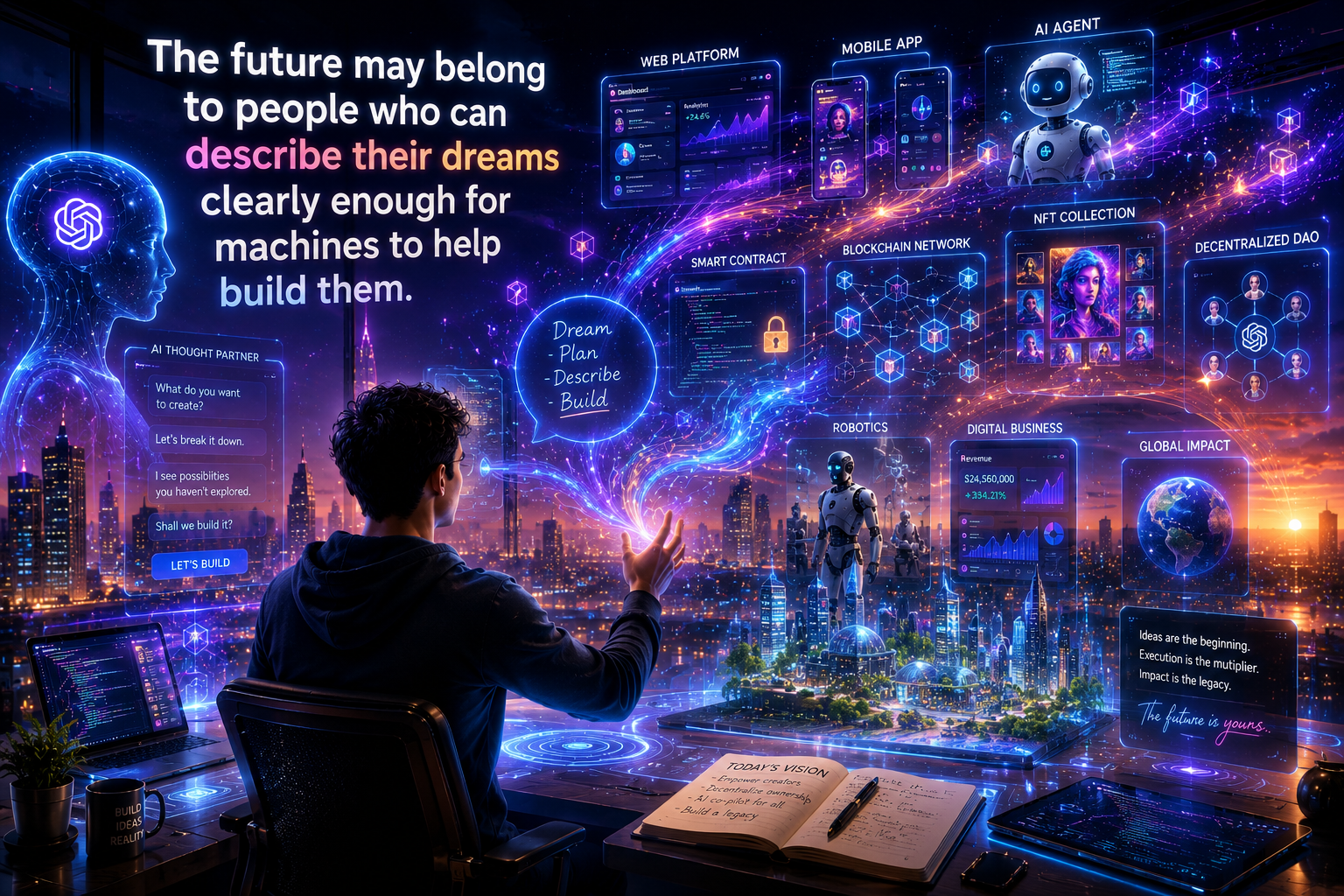
AI as a Thought Partner
Large Language Models like Claude, ChatGPT, and others are often described as assistants.
A better description might be:
Thought partners.
You ask a question.
AI answers.
But then something interesting happens.
The answer often reveals possibilities you never considered.
One question becomes three.
Three become ten.
Entire new directions of thinking emerge.
You start asking:
- What if this also works?
- Why has nobody tried that?
- Could these two ideas be combined?
- What assumptions am I making?
- What second-order effects might occur?
Suddenly you’re no longer simply gathering information.
You’re exploring possibility.
The conversation itself becomes generative.
The Adjacent Possible
Scientists sometimes describe innovation as moving into the “adjacent possible.”
Every new discovery opens doors to other discoveries.
AI accelerates this process dramatically.
You ask:
How can I automate my business?
AI may respond:
- Build an AI agent
- Create workflows
- Use APIs
- Build dashboards
But then new questions emerge:
- Could customers have AI agents?
- Could entire companies operate autonomously?
- Could communities coordinate through AI?
- Could ownership itself become automated?
Ideas begin compounding.
Possibility expands.
You move beyond answers and into exploration.
The End of Blank Pages
One of the hardest parts of creating anything has always been knowing where to begin.
Writers stare at blank pages.
Entrepreneurs stare at empty business plans.
Creators wonder if their ideas are even worth pursuing.
AI changes this dynamic.
Instead of facing a blank page, you can have a conversation.
You can think out loud.
Explore.
Challenge assumptions.
Generate alternatives.
Expand ideas.
The friction between imagination and execution starts collapsing.
Ideas become easier to investigate.
Possibilities become easier to test.
Experimentation becomes dramatically cheaper.
Imagination Becomes More Valuable
Paradoxically, AI may make imagination more valuable, not less.
When software can help with:
- Writing
- Coding
- Designing
- Researching
- Planning
- Analysis
The bottleneck shifts.
Execution becomes increasingly abundant.
Imagination becomes increasingly scarce.
The question changes from:
Can you build this?
to
What should be built?
The future may reward:
- Curiosity
- Vision
- Taste
- Judgment
- Systems thinking
- Creativity
Because if almost anything can be created, deciding what deserves to exist becomes incredibly important.
The Rise of Discovery Intelligence
We’re entering an era where intelligence is becoming conversational.
You no longer need to know exactly what you’re looking for.
You can explore.
Iterate.
Refine.
Challenge your thinking.
Ask impossible questions.
Pursue strange ideas.
AI often acts like intellectual scaffolding.
It helps people think further than they might have gone alone.
The real value isn’t simply receiving information.
It’s expanding what feels possible.
Why This Changes Everything
For centuries, innovation was constrained by:
- Access to knowledge
- Access to expertise
- Access to resources
AI is lowering those barriers.
A single person can now:
- Research like an analyst
- Write like a content team
- Prototype like a startup
- Learn like a student with unlimited tutors
- Brainstorm with an infinitely patient collaborator
The distance between curiosity and capability is shrinking.
The distance between ideas and execution is shrinking.
The distance between imagination and reality is shrinking.
The New Superpower
Perhaps the most important skill of the AI era isn’t coding.
It isn’t prompting.
It isn’t even technical expertise.
It may be learning how to ask increasingly better questions.
Questions create possibilities.
Possibilities create experiments.
Experiments create breakthroughs.
The greatest opportunities of the next decade may belong to people who use AI not merely to get answers, but to think more expansively than ever before.
Because the real magic of AI isn’t that it knows so much.
The real magic is that it can help us discover ideas, opportunities, and questions that otherwise might never have entered our minds.
And sometimes, one new question can change everything.