
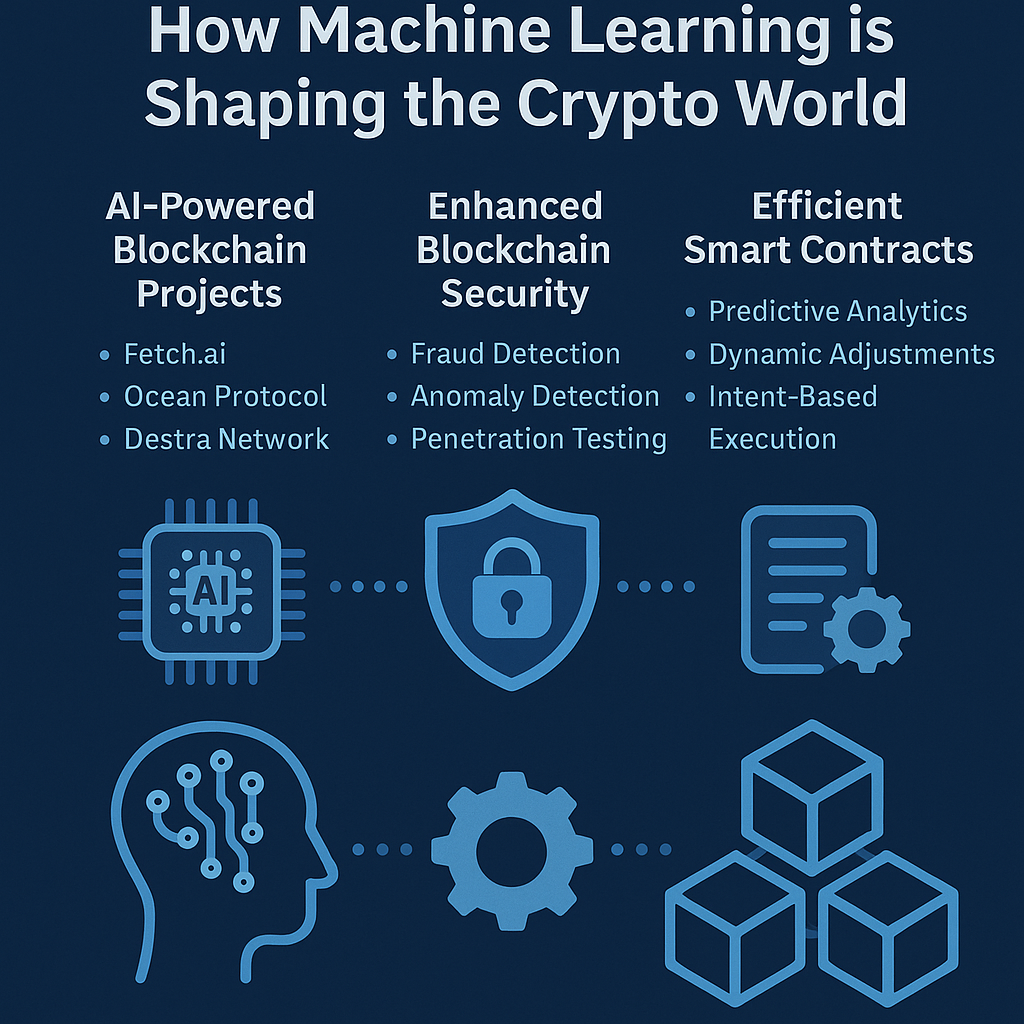
The Intersection of AI and Blockchain: How Machine Learning is Shaping the Crypto World
The convergence of artificial intelligence (AI) and blockchain is rapidly becoming one of the most disruptive forces in technology. As two of the most transformative innovations of the 21st century, AI and blockchain offer complementary capabilities that, when combined, can supercharge security, automation, trust, and intelligence in decentralized systems. This powerful intersection is giving rise to a new wave of intelligent crypto protocols, autonomous finance, smarter contracts, and predictive analytics in decentralized ecosystems.
In this article, we explore how AI is actively reshaping the blockchain landscape—from smarter smart contracts and enhanced cybersecurity to autonomous trading agents and AI-generated crypto economies.
1. AI-Powered Blockchain Projects: The New Frontier
In recent years, an explosion of AI-driven blockchain initiatives has emerged, promising to revolutionize the crypto world. Here are a few standout projects that exemplify this trend:
-
Numerai: A decentralized hedge fund powered by encrypted datasets where data scientists build machine learning models to trade on the stock market.
-
Fetch.ai: A decentralized digital economy powered by autonomous AI agents that perform useful economic tasks like data analysis, prediction, and optimization.
-
Ocean Protocol: A platform that enables secure and privacy-preserving data sharing using blockchain and AI, allowing AI models to train on datasets without exposing sensitive information.
-
Destra Network: An emerging AI-agent infrastructure chain that provides modular, decentralized AI agent tooling for developers, and has gained attention from prominent influencers for its powerful positioning.
These platforms are not just experiments—they are creating the infrastructure for a new generation of intelligent and autonomous applications that live on-chain.
2. Smarter Smart Contracts Through Machine Learning
Smart contracts have been one of blockchain’s most powerful inventions, enabling trustless automation. However, their deterministic nature and rigidity often limit their potential. That’s where AI steps in.
AI-enhanced smart contracts can:
-
Analyze historical transaction data to predict optimal contract execution conditions.
-
Detect anomalies or malicious behavior before executing transactions.
-
Dynamically adjust terms in response to real-world events or data (e.g., adjusting yield farming parameters based on market volatility).
-
Provide intent-based execution rather than requiring hard-coded logic.
For example, Chainlink Functions and dynamic NFTs are already exploring ways to bring off-chain data and AI predictions into the blockchain, enabling more adaptive and intelligent contract behavior.
3. AI in Blockchain Security and Risk Detection
AI is becoming a critical line of defense in the ongoing war against hacks and exploits in crypto. Blockchain security companies are integrating machine learning models that detect suspicious activity before it causes damage.
Applications include:
-
Fraud detection: AI models monitor on-chain activity in real time, flagging wallets or transactions that resemble prior exploits or scams.
-
Anomaly detection: ML algorithms learn “normal” network behavior and identify deviations that may indicate sybil attacks, oracle manipulation, or rug pulls.
-
Penetration testing and bug hunting: Tools like MythX and OpenZeppelin Defender use AI to scan smart contracts for vulnerabilities before they are deployed.
As DeFi and NFT ecosystems continue to scale, AI-driven security will be indispensable.
4. Autonomous Agents and On-Chain AI Economies
A growing number of projects are deploying autonomous AI agents—software entities that act independently on behalf of users, dApps, or DAOs.
In the blockchain context, AI agents can:
-
Trade tokens automatically based on predictive signals.
-
Provide DAO governance recommendations using NLP summarization and sentiment analysis.
-
Execute cross-chain arbitrage in real time.
-
Represent individuals or entities in digital negotiations (e.g., AI lawyers or AI negotiators in token swaps).
For example, Autonolas and Bittensor are working on decentralized AI agent economies where agents are incentivized to perform useful work and earn crypto rewards for contributions to global intelligence networks.
5. Data Infrastructure: Feeding AI with Decentralized Data
AI models are only as good as the data they are trained on. Blockchain solves many challenges associated with centralized data monopolies, bias, and privacy.
Here’s how:
-
Decentralized Data Markets: Platforms like Ocean Protocol and Filecoin allow users to buy, sell, and securely share data for AI training.
-
Federated Learning on Chain: AI models can be trained across decentralized nodes without aggregating raw data, preserving user privacy.
-
Proof of Data Integrity: Blockchain ensures data provenance and immutability, giving AI developers confidence that training data hasn’t been tampered with.
By decentralizing the AI training pipeline, Web3 can usher in a new era of ethical and transparent artificial intelligence.
6. AI-Driven Predictive Analytics in Crypto Markets
Crypto trading has long relied on technical analysis, social signals, and on-chain data. With AI, traders and institutions are now building real-time predictive models using massive datasets from exchanges, blockchains, Twitter, Reddit, and Telegram.
AI trading tools can:
-
Predict short-term price movements using NLP and sentiment analysis.
-
Detect early trends in meme coin activity (e.g., using bots on platforms like DEXTools, KAIKO, or PumpFun).
-
Optimize portfolio allocation based on risk models and behavioral finance patterns.
-
Automate arbitrage, liquidation protection, and yield farming strategies.
Platforms like LORE AI and Santiment are leading the charge in offering AI-powered crypto intelligence.
7. The Rise of AI-Native Cryptocurrencies
We’re now seeing the emergence of AI-native tokens—cryptocurrencies that are inherently tied to AI utility. Examples include:
-
AGIX (SingularityNET) – powering a decentralized AI marketplace.
-
FET (Fetch.ai) – facilitating microtransactions between autonomous agents.
-
TAO (Bittensor) – a blockchain for distributed machine learning training and reward coordination.
These tokens often reflect a dual economic purpose: enabling network utility (e.g., paying for AI services) and rewarding valuable AI contributions.
Final Thoughts: What the Future Holds
The intersection of AI and blockchain is not just a buzzword—it’s the beginning of a technological singularity for the decentralized world. We’re moving toward a reality where:
-
AI agents manage businesses, execute trades, and make strategic decisions.
-
Blockchain provides the trust layer for these agents to operate transparently and cooperatively.
-
Tokenized AI economies reward contributions to intelligence, data, and compute.
The synergy between AI’s cognition and blockchain’s consensus may give rise to a global, decentralized mind—one where intelligence is distributed, programmable, and aligned with human values.
It’s not just the future of finance. It’s the future of everything.